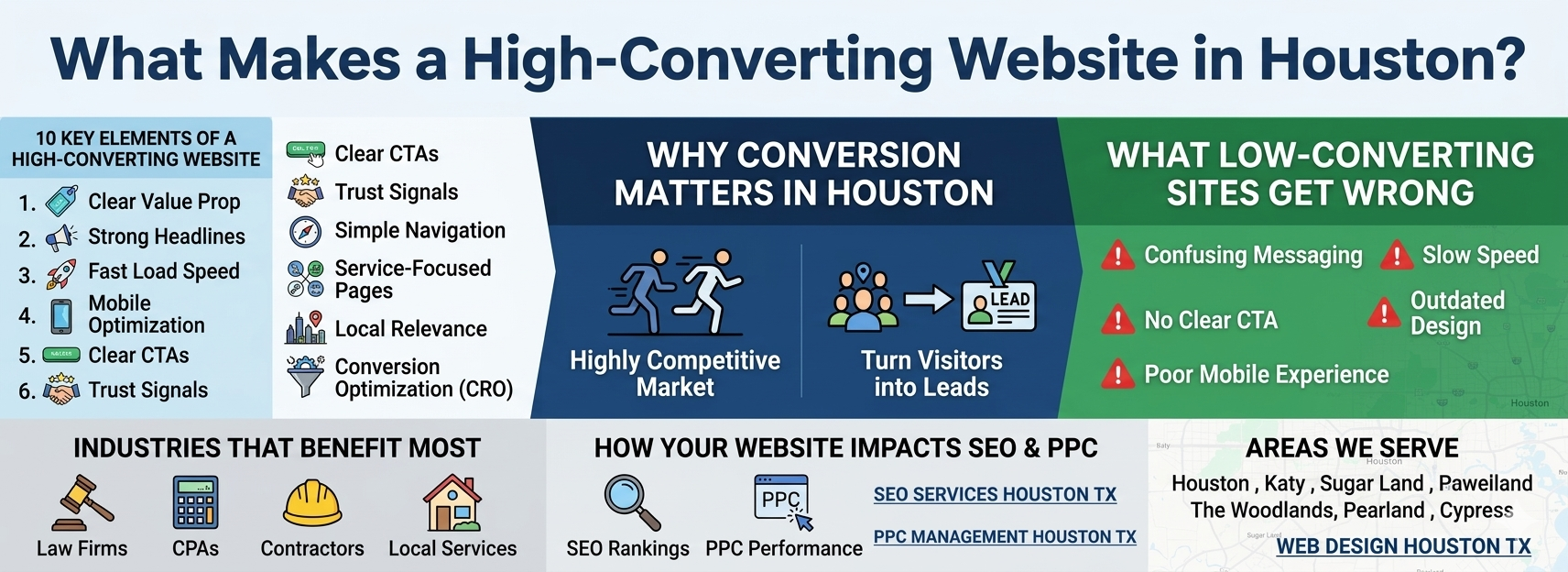
What Makes a High-Converting Website in Houston?
In a competitive market like Houston, getting traffic to your website is only half the battle. The real question is:
Many businesses invest in SEO and Google Ads—but still struggle to generate results. Why?
Because their website isn’t built to convert.
In this guide, we’ll break down exactly what makes a high-converting website in Houston—and how you can turn your site into a lead-generating machine.
A high-converting website is designed to:
Instead of just looking good, it focuses on:
Clear Value Proposition
Within seconds, users should understand:
If users are confused, they leave
Strong Headlines
Your headline must:
Fast Load Speed
Speed is critical.
If your site takes too long, users leave before it loads
Mobile Optimization
Most users are on mobile. Your site must:
Clear Calls-to-Action (CTA)
Every page should guide users to:
Without CTAs, no conversions
Trust Signals
Users need confidence. Include:
Simple Navigation
Your site should be easy to use. Users should find information quickly and navigate without confusion.
Service-Focused Pages
Each service should have its own page.
Local Relevance
Houston users want local businesses, familiar locations, and nearby services.
Conversion Optimization (CRO)
Your website should be tested and improved over time.
Confusing Messaging
Users don’t understand what you offer.
Slow Speed
Users leave before engaging.
No Clear CTA
Visitors don’t know what to do next.
Outdated Design
Trust is lost instantly.
Poor Mobile Experience
Most traffic is mobile.
Typically 3–10% depending on industry. Service-based businesses often see higher rates than e-commerce.
Yes—it directly affects conversions. A well-designed site with clear CTAs can double or triple your lead generation.
Focus on speed, clarity, and user experience. Start with strong headlines, clear CTAs, and mobile optimization.
If your site isn’t converting, likely yes. An outdated or poorly structured site costs more in lost leads than a redesign.
Turn Your Website Into a Lead-Generating Machine
If your website isn’t generating leads, it’s not doing its job. The key is:
Search by posts
Calendar
| M | T | W | T | F | S | S |
|---|---|---|---|---|---|---|
| 1 | 2 | 3 | 4 | |||
| 5 | 6 | 7 | 8 | 9 | 10 | 11 |
| 12 | 13 | 14 | 15 | 16 | 17 | 18 |
| 19 | 20 | 21 | 22 | 23 | 24 | 25 |
| 26 | 27 | 28 | 29 | 30 | 31 | |